HISTORICAL CONTEXT      RE-CREATING BARNUM'S MUSEUM
CREDITS      SPONSORS
HOW TO EXPLORE THIS SITE
COMMENTS/CONTACT US

HISTORICAL CONTEXT
Barnum's American Museum has been long recognized by historians as a pivotal institution in the development of nineteenth-century urban culture. Foreshadowing trends in American commercial amusement, the Museum was the first institution to combine sensational entertainment and gaudy display with instruction and moral uplift. For a twenty-five cent admission, visitors viewed an ever-revolving series of "attractions," from the patchwork Fejee Mermaid to the diminutive and articulate Tom Thumb. But the Museum also promulgated educational ends, including natural history in its menageries, aquaria, and taxidermy exhibits; history in its paintings, wax figures, and memorabilia; and temperance reform and Shakespearean dramas in its Lecture Room or theater. In one site, the Museum gathered exhibitions and amusements that previously had been offered in separate milieus; equally important, it also drew a new audience that reflected the increasingly heterogeneous population of the American city. In an urban culture characterized by increasing difference--in taste, in subject, and in audience--Barnum's American Museum was a singular institution where, in one place, immigrants and native-born, working-class and middle-class, men and women, city residents and rural visitors could gather. However, until the Civil War African Americans were barred from the Museum, as they were from most antebellum New York commercial amusements

Accurately ascertaining the appearance of Barnum's American Museum represents a research as well as imaginative challenge. Aside from P. T. Barnum's perpetual rearrangement of its exhibits and attractions, documentary evidence about the way the Museum looked is elliptical and inexact. Guides such as the 1850 Barnum's American Museum Illustrated and occasional newspaper articles indicate the building's general layout and the contents of its exhibitions at specific moments in time. There are a number of photographs, prints, and paintings of the Museum's exterior as well as of many of its "transient attractions," but the only visual evidence of the building's interior resides in a limited number of wood-engraved illustrations from Barnum-sponsored publications and the weekly illustrated press. While these pictures provide us with the best sense of where exhibits were placed and how the rooms were arranged, comparison with contemporary insurance maps indicates that the dimensions they portray are wildly inaccurate. Nevertheless, with the assistance of historical advisors, we can create a well-informed, detailed estimation of what the Museum was like.

Back to top

RE-CREATING BARNUM'S MUSEUM
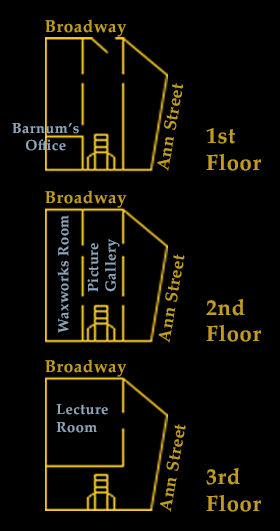
The first phase of The Lost Museum was completed in 1999 with the release of a prototype CD-ROM exploration of the Picture Gallery, produced at the New Media Lab at the City University of New York Graduate Center with the support of a development grant from the National Endowment for the Humanities. The second phase was completed a year later with the debut of the Picture Gallery and a supplementary Archive of achival documents as a website. With the support of a production grant from NEH in 2001, we are now engaged in the third phase of the virtual reconstruction of the American Museum. October 2002 marks the premiere of the Waxworks Room, an expanded and now fully searchable Archive, and a new Classroom feature offering ways to use The Lost Museum in a range of school settings. Having completed the second floor of the Museum, we will now move on to other floors. P. T. Barnum's office and the popular amphitheater Lecture Room will be the next spaces available for exploration in the near future.

To re-create Barnum's American Museum, we are using a sophisticated 3-D animation program, SoftImage. The process begins by mapping out the pathway of a visitor to the virtual Museum site in the form of a storyboard sequence linked to the layout of the Museum's second floor. Each storyboard view is then rendered as a two-dimensional plan in preparation for development in SoftImage, where virtual wireframe models of the building itself and each item in the building are created. "Textures" are added in order to create a realistic look. The items are then positioned in the room and a system of lighting is developed for the site's ambience. Animations are created in Softimage and Flash. A Flash movie allows the user to explore the room.

Since its virtual unveiling in 2000, The Lost Museum has been covered in the New York Times, CBS News Sunday Morning, National Public Radio, and AAA World, and received citations for excellence (incuding the Archivists Round Table of Metropolitan New York's 2000 Award for Innovative Use of Archives and the 2002 Big Brain Award for Outstanding Educational Sites).

Back to top

CREDITS
American Social History Project/Center for Media and Learning
The Graduate Center, City University of New York
in collaboration with
Center for History and New Media
George Mason University


Joshua Brown, Roy Rosenzweig - Executive Producers
Andrea Ades Vasquez - Project Director/Art Director
Pennee Bender - Producer
Ellen Noonan, Joshua Brown - Writers
Lee Ann Pomplas-Bruening - 3-D Animator, Picture Gallery and Waxworks Room
Brian C. Muller - 3-D Animator, Lecture Room
Cortlan McManus - 3-D Animator, Barnum's Office
Fernando Azevedo, Cristina Yunzal, Liliana Halim - Additional Animation
Steve Prince - Additional Writing
Andre Pitanga - Head Web Programmer
Burc Acar, Christopher Terry - Additional Programming
Elena Razlogova, Gene Yu, Michael Laine, Andre Pitanga - Database Programmers

ICONOCLAST (Julie Joslyn, Leo Ciesa) - Music
Pat Muchmore - Sound Effects

Sam Hurlbut, Carol Greski, Isa Vasquez, Peter Buckley, Markeisha Ensley, Frank Poje, David Carson - Voiceover Actors

Special thanks to Madelyn Kent, curator of the Old York Library, for her archival discoveries.

Advisors:
Bluford Adams, Department of English, University of Iowa
Elizabeth Blackmar, Department of History, Columbia University
Stephen Brier, The Graduate Center, City University of New York
Peter G. Buckley, Department of History, The Cooper Union
James (Jay) Cook, Department of History, University of Michigan
Ann Fabian, Department of History, Rutgers University
Kevin Kenny, Department of History, Boston College
Michael O'Malley, Department of History, George Mason University
Ann Fabian, American Studies and History, Rutgers University
Neil Harris, Department of History, University of Chicago
Benjamin Reiss, Department of English, Tulane University

Back to top

SPONSORS
National Endowment for the Humanities
Old York Foundation

Back to top

HOW TO EXPLORE THIS SITE
The Lost Museum is composed of three interrelated sections: A three-dimensional interactive Museum, a searchable Archive of primary documents and supplementary information, and a Classroom with teaching activities, background essays and other resources.

The heart of the website is the 3-D Exploration. Download time to access the Flash movie for each room will vary depending on your Internet connection and the speed of your computer. Please note that you need Flash Player 6 to undertake the 3-D exploration (click here for the free Macromedia Flash Player download page). Once the movie downloads you should have no problem moving around each room and inspecting its many features and clues. Move your mouse over the image to go left, right, up and down--arrows will appear on either side of the screen when there is more to see. A question mark (?) indicates that you can take a closer look at a particular part of the room--click your mouse to move in.

You can access the three Lost Museum sections separately. Or, when you're exploring the Museum you also can move between your 3-D visit and the Archive--just look for the Archive button beneath the screen.

BACK

COMMENTS/CONTACT US